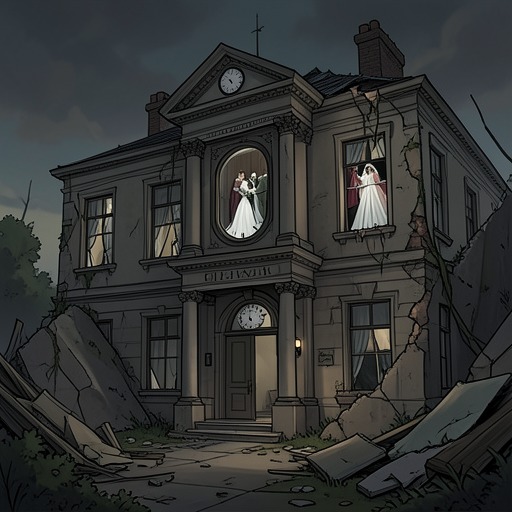
Miss Havisham’s bridal dress
Great ExpectationsMiss Havisham’s bridal dress is both a material remnant of an interrupted wedding and the most visible emblem of the time Miss Havisham has refused to leave behind. Its gradual change from white finery to faded, yellowed cloth parallels the wearer’s decline, shapes Pip’s first impressions of Satis House, and recurs in his memories long after the dress itself is destroyed in a fire.
Appearance and First Encounter
The dress appears when Pip enters the candlelit dressing-room at Satis House. Miss Havisham wears white satin, lace, and silk, with bridal flowers and a long veil, but her preparations are incomplete: she has only one shoe on, the other rests on the dressing-table, and her watch, chain, lace, gloves, and prayer-book lie among other scattered belongings. Half-packed trunks and less splendid dresses remain around her. The room’s abandoned preparations make the garment part of a larger scene of a wedding that seems never to have concluded.
The first impression of whiteness quickly gives way to evidence of decay. The dress has lost its lustre and turned yellow, like the flowers and other things that should once have been white. It hangs loosely on Miss Havisham’s diminished figure, so that the old bridal finery and the body wearing it seem to have withered together. Pip’s attention to the dress is bound up with the room’s other conspicuous relics: the stopped watch and clock both mark twenty minutes to nine, while the unworn shoe on the table and the worn stocking on Miss Havisham’s other foot register the passage of years through neglected objects.
The Dress as a Scene of Arrested Time
The garment’s force comes not only from its age but from its place among objects that appear to have been preserved in the instant of the wedding’s interruption. Miss Havisham puts a jewel back exactly where she found it; the bridal shoe remains unworn; the room’s faded furnishings and the dress itself seem held apart from ordinary use and change. As Pip watches Miss Havisham and Estella play cards, the dress’s frills resemble dry, earthy paper, and its veil suggests a shroud. The wedding clothes therefore hold two opposed meanings at once: they recall a celebration and resemble the coverings of death.
This arrested scene is also a form of performance. Miss Havisham keeps the wedding dress on as she observes Estella and Pip at cards, drawing attention to Estella’s beauty and heightening Pip’s awareness of his own appearance. The child, newly exposed to Estella’s scorn for his hands and boots, begins to feel ashamed of them. The bridal relic is thus not merely a private memorial: situated in the room where Miss Havisham directs the encounter, it helps frame Pip’s early experience of social humiliation and aspiration.
Memory, Repetition, and Intended Burial
The dress and its surroundings return in Pip’s imagination as well as in the house itself. In the brewery, he once sees a sudden vision of Miss Havisham hanging from a beam, recognizable by the yellow-white dress and its faded trimmings; he runs toward the figure and finds nothing there. The episode is a frightening fancy, not an actual event, but it establishes how readily the bridal image can reappear in altered form. Much later, revisiting the brewery, Pip again thinks he sees Miss Havisham hanging from the beam. The impression proves momentary, yet it shows that the old association still governs how he sees the neglected place.
Miss Havisham explicitly links the dress to her death. On the anniversary of the day the wedding remnants were brought to the table, she points toward the accumulated decay and says that it and she have worn away together. Holding her stick against her heart as she looks at the yellowed cloth and surrounding ruins, she declares that she is to be laid dead in her bride’s dress on the bride’s table. She imagines this final tableau as the completion of a curse on the man associated with her ruin. The garment’s future role in that imagined burial extends the wedding’s arrested time beyond life itself.
Destruction and Aftermath
The dress is finally consumed when a flame suddenly springs up around Miss Havisham and she runs toward Pip. He uses his two coats and the tablecloth to smother the fire. The struggle brings down the rotting heap on the table, and the dress is reduced to patches of tinder still alight in the smoky air. Its destruction ends the garment’s physical presence, but does not immediately erase the image attached to it: when Miss Havisham is seen afterward, white cotton-wool and a sheet cover her, preserving a ghostly echo of her former bridal appearance.
During her illness, Miss Havisham repeatedly asks what she has done and says that, when Estella first came, she meant to save her from misery like her own. She also asks Pip to write a declaration of forgiveness under her name. These words connect the dress’s long history of memorializing her injury to her late recognition of the harm it has accompanied. The garment has marked not only her private grief but the world she constructed around Estella; its destruction occurs alongside an admission that the intended protection became a source of misery.
Narrative and Thematic Significance
The dress makes time legible through material change: its lost whiteness, loosened fit, and deteriorating trimmings give visible form to the years Miss Havisham has spent in mourning. In conjunction with the stopped clocks, dusty rooms, and unfinished wedding preparations, it turns Satis House into a place where memory is not simply recalled but maintained through objects. The garment’s appearance first invites Pip to read the scene as strange and frightening; its later recurrence shows how the image has entered his own memory.
Its meaning also shifts across the story. It begins as wedding attire still being worn, becomes an emblem of decay and revenge, and is ultimately destroyed while Pip tries to save its wearer. After the fire, Miss Havisham’s request for forgiveness changes the moral emphasis of the bridal relic: what had served as a continuing monument to injury is associated at last with regret and the possibility of reconciliation. Even when no longer intact, the dress remains a powerful image through which Pip remembers the cost of living inside the past.